Inside AI-Powered Training 01
Why Building a Training Plan Is Harder Than It Looks
The core challenge of AI training planning isn't being "smart," but constraint management—the complex interplay between equipment capabilities, training goals, recovery needs, and scheduling. Moving from "train with what you have" to "train with what's suitable," AI must find balance at the intersection of constraints: same goals require different approaches with different equipment, adjacent training days have invisible recovery chains, and week-over-week progression cannot rely on cutting rest. The real challenge is translating exercise science principles into constraint solving.
Wenjun Zhu / XIaoya Lin / Chao Zhang

Contents
A trainee owns just one piece of home equipment: an exercise bike. What training plan should we build for them?
The instinctive response is to “use what is available”: if the user can cycle, prescribe cycling—45 minutes a day, five or six days a week, with their heart rate kept in the aerobic zone. Equipment utilization earns full marks, but the training outcome may score zero from the user’s perspective. What if their goal is to build muscle? Giving someone who wants full-body muscle gain a week of cardio, or resistance work limited to the lower body, sends them in the wrong direction. The harder they work, the further they move from their goal.
This is only the simplest analogy, but variations of the same scenario appear in our system every day. Over the past two years of building the Speediance AI training-plan system, one conclusion has become increasingly clear: the core challenge is not a lack of intelligence in the AI. It is that training goals, equipment capabilities, scheduling constraints, and recovery needs naturally pull against one another. Once we expose those conflicts and ask the AI to arrive at the right answer reliably on every generation, "right" stops being obvious. It emerges from several competing constraints colliding inside a very small solution space.
The Same Goal, a Completely Different Playbook
With some training experience, the goal of “building muscle” may immediately suggest an intuitive plan: resistance training as the foundation, a chest/back/legs split, three or four sessions per week, and an intensity geared toward hypertrophy. For AI, however, that compressed idea must be unpacked rigorously and scientifically. Every step in the process changes depending on the equipment available.
Consider Speediance hardware. Gym Monster is a cable-and-barbell strength system that supports a wide range of resistance exercises, along with selected cardio modes. VeloNix is a smart cycling system built for aerobic work across multiple intensity levels.
The straightforward case is a Gym Monster owner who wants to build muscle. The AI can program resistance sessions on Gym Monster for the chest, back, legs, and other muscle groups.
But what if a user owns only a VeloNix and wants to build muscle? In principle, a cycling device can support resistance training only for the lower body. The right approach is to deliberately leave VeloNix out of most training days, using it only for appropriately dosed cardio and lower-body resistance work, while filling the rest of the plan with other forms of off-device resistance training.

There is a subtler case. Suppose the user has such a limited aerobic base that even moderate continuous cardio is unsustainable. Gym Monster may offer rowing and skiing modes, but their intensity curves can still be too steep for a beginner. The user's heart rate may shoot past the anaerobic threshold within minutes, bringing the session to an early stop and potentially creating unnecessary risk. A better starting point for the first week or two may be low-intensity walking or very easy cycling.
Rather than maximizing equipment utilization, our AI should prioritize the training approach that best fits the user. After all, tools are just tools, it should not lock you into a particular training path.
At this point, the AI has defined the frame for a workout. But the workout itself contains another layer of logic. A complete session should have three parts: a warm-up, the main training block, and a cooldown. Each part has a specific job to do; none is ceremonial.
A warm-up is more than simply "moving around". It should activate the joints and movement patterns used in the main session: hips, knees, and ankles on leg day; the rotator cuff and thoracic spine on upper-body day. Selecting the right warm-up requires a clear understanding of the exercises that follow. The same principle applies to the cooldown.
The main training block has its own sequencing principles. Compound movements generally come before isolation work, and larger muscle groups before smaller ones. If a session opens with a single-joint isolation exercise, the nervous system may not be adequately prepared for the heavy compound work that follows.

Each of these constraints has a scientific rationale. The real challenge is making every constraint explicit, evaluating them together, and ensuring that none is missed across a thousand generations. Human coaches may have off days; an AI system should deliver consistent, reliable performance every time.
And that covers only session structure. Intensity programming is no easier. For the same Gym Monster resistance session, the AI must determine whether the objective is hypertrophy, maximal strength, or muscular endurance. Those three targets produce very different adaptations. Cardio has even finer intensity layers, from threshold work to VO2max development and fat-oxidation-focused sessions. Two users with the same fat-loss goal should not receive the same intensity if one is a beginner and the other is advanced.
When equipment, intensity, and all the other variables interact, the AI is not choosing A or B. It is traversing a branching decision tree. Every node must be resolved as part of the same reasoning chain. Skip one, and everything downstream inherits an incomplete plan.
Scheduling Is Not Calendar Filling. It Is Finding a Path Through Constraints.
A training timeline is fundamentally different from ordinary calendar scheduling. A calendar only has to place the right event at the right time. A training plan must account for the body's continuous physiological response, starting with the very first training stimulus.
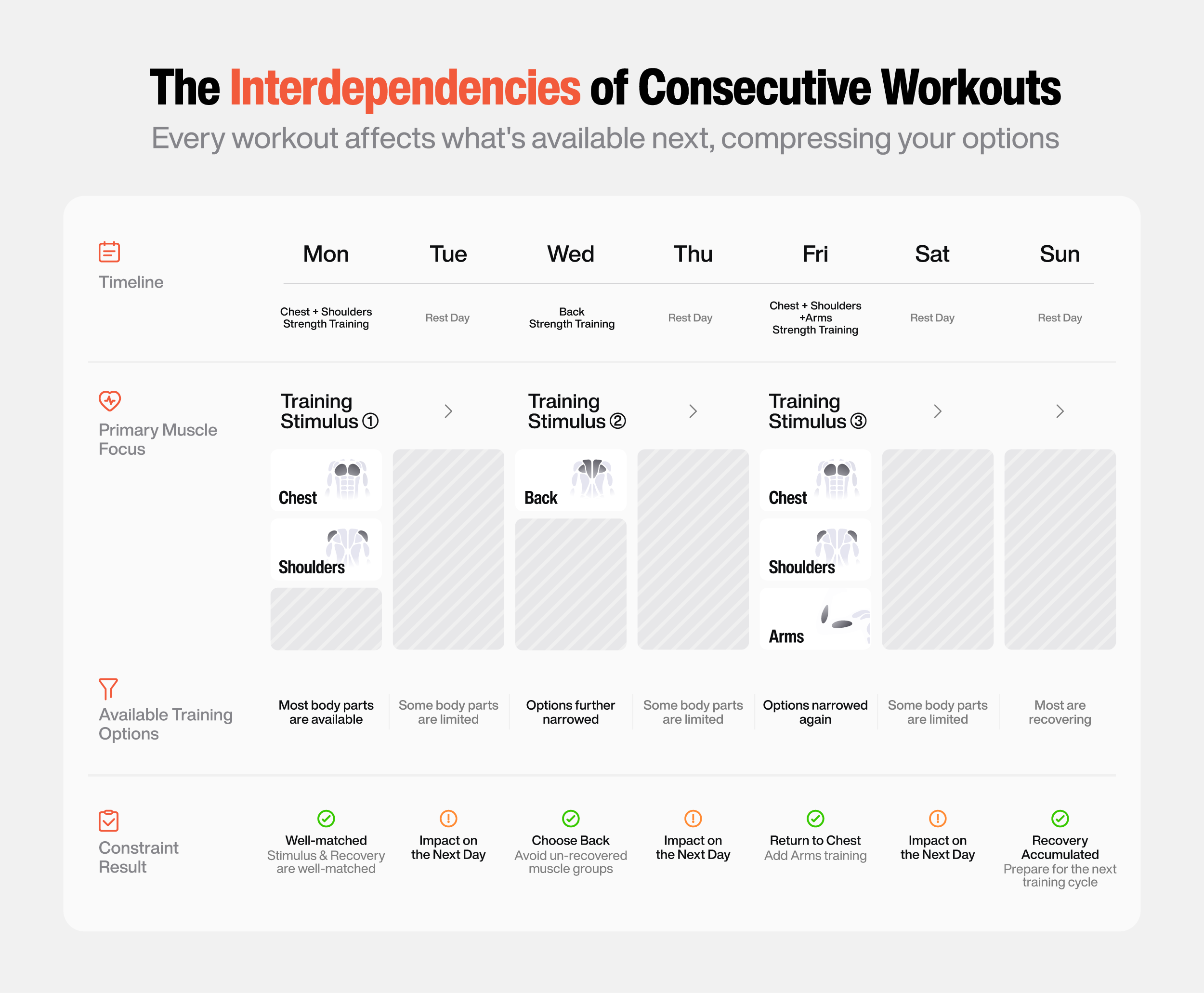
The harder problem begins after the schedule looks complete: a seemingly reasonable plan may be pushing the user, week by week, into a recovery deficit.
Here is a mistake we encountered in practice. We built a four-week plan in which week one had four training days and three rest days. By week three, the user's performance data had improved, so the AI scheduled five training days and two rest days. Week four increased that to six training days and one rest day. None of those weeks looked unreasonable enough to veto in isolation. Across the full plan, however, rest fell from three days to two and then to one - precisely as training intensity peaked in the progression phase. The user did not see it, and the system did not flag it, but the plan's momentum was steadily pushing them into a recovery deficit.
The mistake was to confuse progressive overload with progressively removing rest. Overload should improve the quality of the training stimulus - through load, complexity, or density - rather than relentlessly strip away recovery time. Higher-intensity training requires more recovery, not less. Without a cross-week trend check, the problem can spread silently through the entire four-week plan. Each week appears reasonable on its own; together, they create a chronic failure mode.
AI therefore cannot plan one day at a time. It has to evaluate the four-week picture at once: whether each week provides enough rest, whether load is progressing too aggressively across weeks, and whether adjacent sessions avoid repeating the same stimulus whenever possible.
And the relationship between adjacent sessions goes beyond avoiding repetition. They form an invisible recovery chain.
Suppose Monday trains the chest and shoulders. Over the next 48 to 72 hours, those muscle groups are recovering and adapting. That process needs time, so Wednesday should avoid loading them heavily again. The immediate options narrow to legs, back, or arms - and even those choices require another pass.
A hard leg session can impose a large systemic and central-nervous-system demand. Monday's workout focused on the upper body, but heavy pressing can also carry a meaningful CNS cost that may not be fully cleared by Wednesday. Training legs hard is not necessarily wrong, but this may not be the best recovery window. Back training can be the more conservative choice: it still targets a large muscle group and delivers high training value, usually with less systemic demand than a hard leg session. So Wednesday becomes a back day.

By Friday, less than 48 hours has passed since the back session, so those muscles are likely still recovering. Chest and shoulders, however, were trained four days earlier and are much more likely to be ready. Chest, shoulders, and legs can all return to the option set. Based on the user's preference, we program chest, shoulders, and arms, balancing upper-body pushing with complementary arm work.
Every AI decision is connected to decisions on other days. The moment Monday's session ends, it has already drawn Wednesday's exclusion zone and marked Friday's return window. The three training days are not three independent schedules. They are interlocking pieces of the same puzzle, and the constraints between days are even easier to miss than the constraints inside a single session.
Constraint Management Is Harder Than Information Management
We initially thought of training-plan creation as "collect requirements, then fill a template": ask for the goal, available equipment, and free time, then generate the sessions. That model works when there are only a few variables. As more factors enter, the template begins to fail. Beyond the interactions among goals, equipment, and recovery, accessory selection, workout efficiency, and training variety push the solution space further into a corner.
We are not inventing a new training philosophy. We are transferring principles validated over decades of exercise science from textbooks into AI decision-making. The ACSM's FITT-VP framework - frequency, intensity, time, type, volume, and progression - provides a general structure for exercise prescription. The NSCA's periodization principles add guidance on load-recovery balance and muscle-group rotation across training phases. The hard part begins when an ACSM frequency guideline meets the user's actual equipment, or when an NSCA recovery principle meets the user's scheduling preferences. Those constraints do not always coexist neatly.
Every new condition removes a set of previously viable plans and shrinks the space in which a feasible solution can survive. What first looked like an addition problem becomes an intersection problem - and that intersection rapidly approaches zero as more dimensions are added.
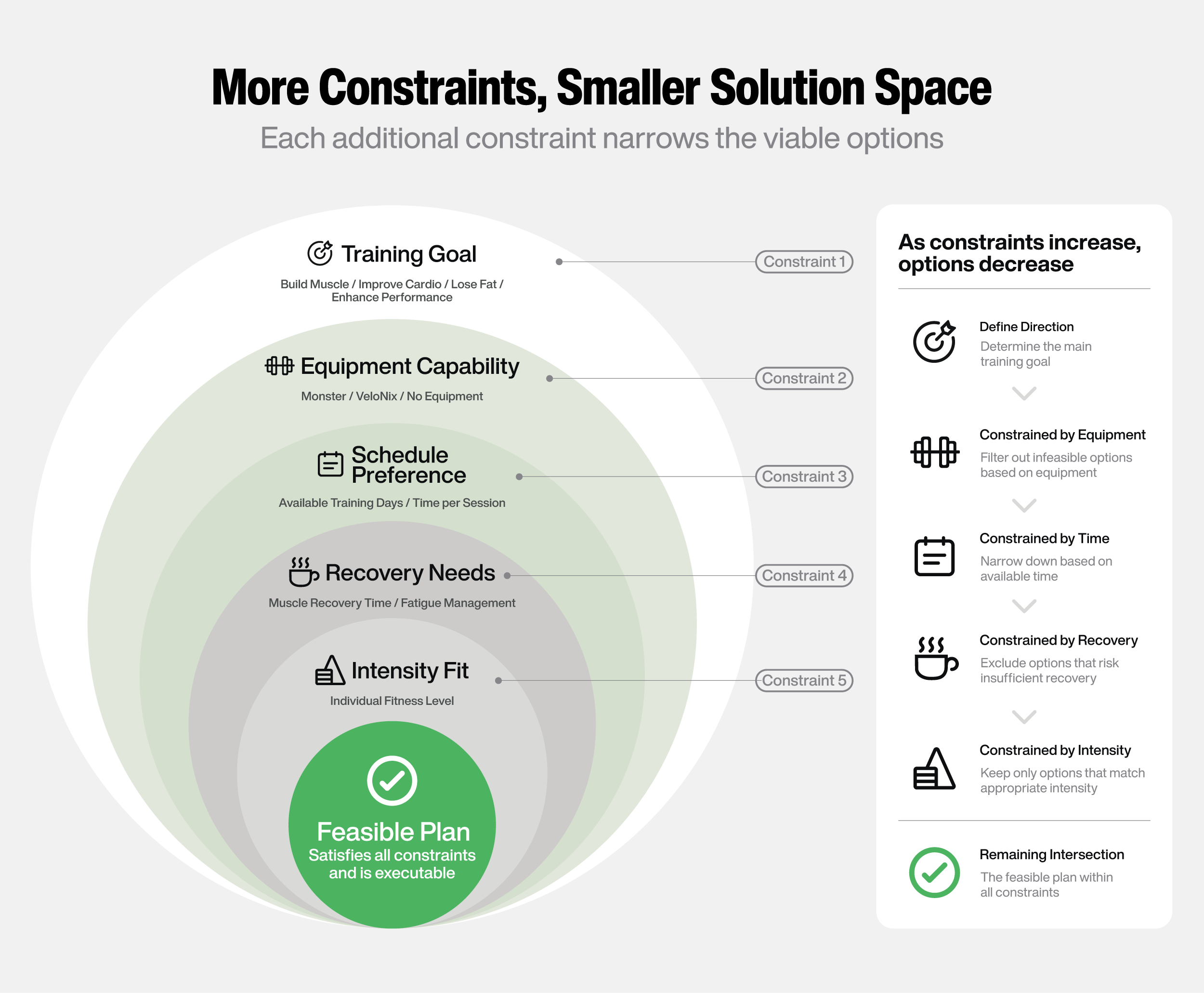
A genuinely good training plan is one of the very few feasible solutions inside the intersection of all known constraints. User intent, equipment capability, the guardrails of training science, and the reality of time all pull on every training day. The AI's job is to find an equilibrium where none of those forces overwhelms the others. That is the real difficulty behind AI-generated training plans.
How do we compute that intersection in practice? And once the direction of each session is known, how should the exercises themselves be selected and sequenced? We will unpack both questions in the next article.