We Have More Health Data Than Ever. So Why Aren’t We Healthier?
Wearable devices surge but diabetes prevalence doubles; data explosion hasn't improved health. Health is fundamentally a behavioral system—we lack "doing," not "knowing." The CARE Loop (Collect-Analyze-Recommend-Execute) lowers action barriers to drive natural behavior. True AI health intelligence should be a continuously running "health operating system," helping users consistently do what they know but struggle to maintain. The future belongs to systems that drive behavioral change.
Xiaoya Lin / Chao Zhang
Contents
- We have more health data than ever, but we have not become healthier
- Health problems have never been knowledge problems
- From information systems to control systems
- Next-generation health intelligence should reduce cognitive cost
- CARE Loop: the closed loop that keeps health intelligence running
- We are building a health operating system that keeps running
We have more health data than ever, but we have not become healthier
Over the past few years, AI has been moving quickly into health. From training plan generation, nutrition advice, and sleep analysis to products described as AI Coach, AI Trainer, or AI Wellness Assistant, more and more companies are trying to use large models to redefine personal health management.
From a technical perspective, this shift is exciting. Today's AI can already understand complex problems, integrate large bodies of knowledge, and interact with users in a way that feels close to a human coach. Many people therefore believe that the health industry is about to enter a major transformation driven by artificial intelligence.
However, if we shift our attention from model capability to user outcomes, a more sobering pattern appears. Global wearable device shipments grew from around 100 million units in 2014 to more than 600 million in 2025 (IDC, 2025). At the same time, the global prevalence of diabetes among adults rose from 7% in 1990 to 14% in 2022, with the total number of patients exceeding 800 million (WHO/NCD-RisC, 2024). Between 2010 and 2023, the disease burden associated with high BMI and high blood glucose increased by 11% and 6%, respectively (IHME GBD study, 2025).
Data is growing explosively, but health outcomes have not improved in step.
Here’s the reality: someone who just sat through three hours of meetings, landed in a new city, and caught only five hours of sleep doesn’t need to be told they’re tired. They don’t need another 'perfect' weekly training plan. They need to know exactly what to do today—and how much.
Instead, users remain trapped in a cycle of starting and abandoning training plans. Their exercise habits are still disrupted by work pressure. They still feel confused despite having large amounts of health data. Many people can accurately state their resting heart rate, sleep score, and body fat percentage, yet still do not know whether they should train or rest today, or whether the effort they have put in over the past few months is actually making them healthier.
Health problems have never been knowledge problems
We think this is happening not because AI is still not powerful enough, but because the industry's understanding of "health intelligence" remains trapped in an overly narrow frame.
Most so-called AI health products today are still, at their core, solving the problem of information access: helping users get answers faster, understand data more conveniently, and make plans more easily.
But health has never been only an information problem.
For most adults, the health domain is not short on knowledge. Most people know that regular exercise matters, that lack of sleep carries risks, and that long periods of sitting are bad for the body. Over the past several decades, medical research and public health education have made this knowledge more widely available than ever before. If knowledge alone were enough to solve the problem, we should already be living in a much healthier world than the one we have.
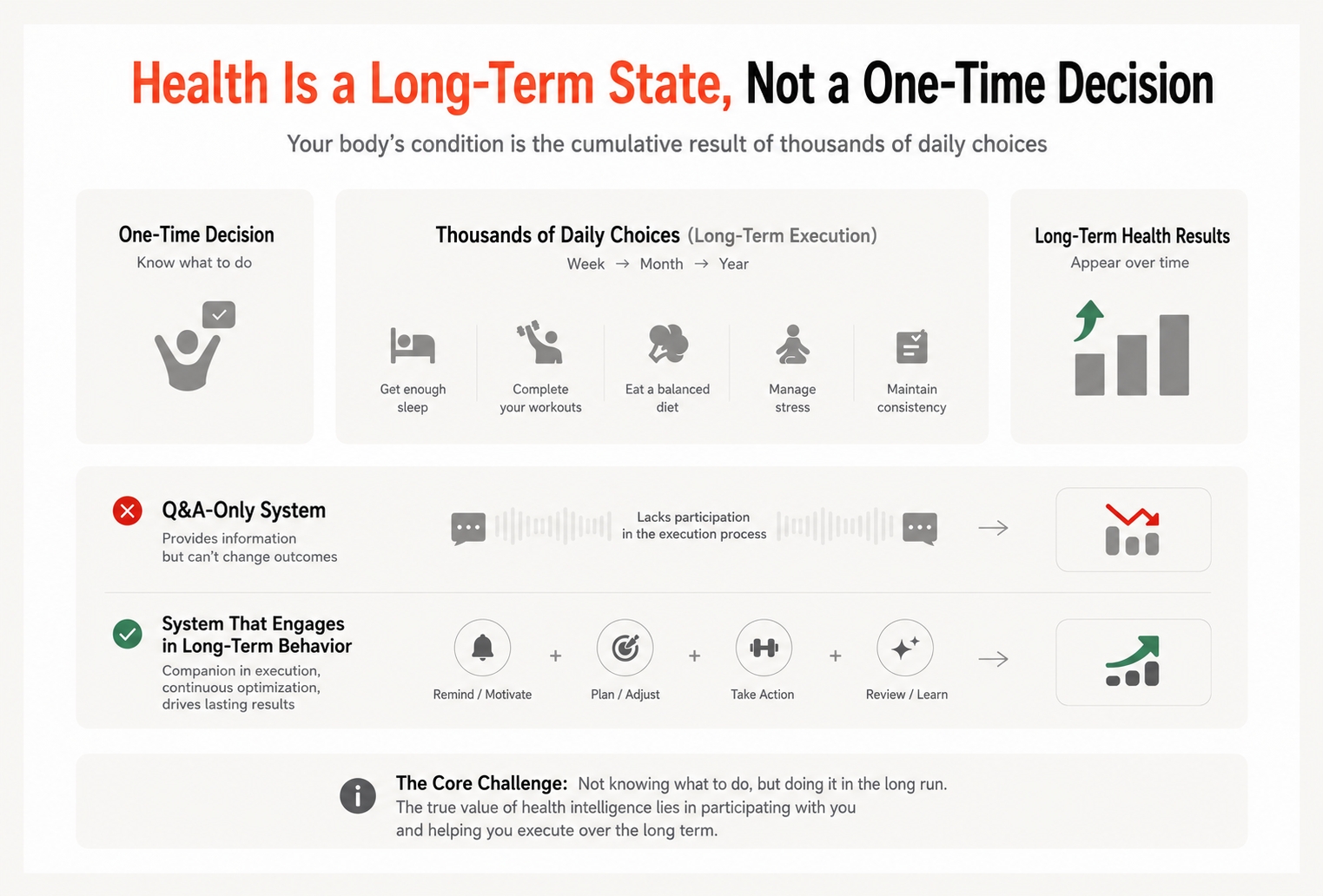
The truly difficult part is that health is a long-term state, not the result of a single decision.
A person's physical state is the accumulation of thousands of everyday choices: whether they go to sleep on time, whether they complete training, whether they sustain a reasonable diet over time, and whether they adjust their life rhythm when pressure increases. Unlike most digital products, health behavior and health outcomes are often separated by a long time horizon.
Finishing one workout today does not immediately produce a stronger body. Reducing one late night today does not immediately improve health risks over the next several years.
The core challenge in health does not occur at the moment of "knowing what to do." It happens throughout the long execution process that follows. Therefore, if a system can only answer questions but cannot participate in the formation of a user's long-term behavior, then no matter how strong its knowledge capabilities are, it will struggle to change the final outcome.
From information systems to control systems
This is why we increasingly understand health management as a long-term behavior system, rather than an information system.
Over the past decade, the industry has invested heavily in collecting and quantifying human data. Smart watches record activity and heart rate, wearable devices monitor sleep and recovery, smart fitness equipment records training performance, and all kinds of applications track nutrition intake, weight change, and movement routes.
Seen locally, each product is becoming more intelligent. But from the user's perspective, this intelligence is highly fragmented.
Training data lives inside the training system. Sleep data lives inside the sleep system. Diet data lives inside the diet system. Work pressure, travel schedules, life habits, and long-term goals often do not exist in any system at all.
As a result, as data becomes richer, the person who has to do the real thinking is still the user. Users have to understand the relationships between different metrics, decide which recommendations are worth following, judge whether today should be a training day or a recovery day, and stitch information from multiple systems back into a complete story about themselves. Health technology is creating more and more information, but it is not reducing the cost of understanding that information accordingly.
When we reexamine health management itself, a basic fact becomes clear: health is not a process of understanding the body. It is a process of influencing the body.
A person does not become healthier because they know their body fat percentage. They do not sleep better because they understand the principles of sleep. What creates change is the behavior that follows. Whether training is completed, diet is adjusted, sleep is improved, and stress is managed, these ongoing actions ultimately determine health outcomes.
From this perspective, health management looks more like a dynamic control system than an information system. It needs to continuously sense the body's state, understand why changes are happening, decide the next action, observe the result of that action, and then adjust future decisions. This process does not end, because the human body itself is always changing.
Next-generation health intelligence should reduce cognitive cost
This is also why we think the key direction for future health intelligence may be different from what many people expect. We increasingly believe that the important question is how to reduce the cognitive cost of health management itself.
For most high-intensity workers, the biggest enemy of health is not a lack of motivation. It is not having enough energy to keep paying attention to their health. Your time should be spent on decisions that truly matter, not on deciding whether you should train today. If a system requires users to study data, understand reports, and adjust plans every day, then no matter how accurate its analysis is, it will be difficult to become a long-term solution.
Truly excellent health intelligence in the future should be able to take on complexity proactively. It should hide the analysis, judgment, and coordination work behind health management, and present users only with the action most worth taking.
When we start thinking about health from the perspective of long cycles and low mental effort, our expectations for AI also change. We no longer see AI as an assistant that can answer questions, but as a system that can continuously understand the user. It needs to understand not only one day's training data, but the user's behavior patterns over the past several years; not only the current physical state, but also long-term goals, preferences, habits, and living environment. It needs to know why the user always interrupts training during business travel, why certain plans can be sustained over time, and why sleep is the first thing affected when pressure rises.
Only when these long-term contexts can be continuously accumulated and used does AI begin to have health intelligence in the true sense.
CARE Loop: the closed loop that keeps health intelligence running
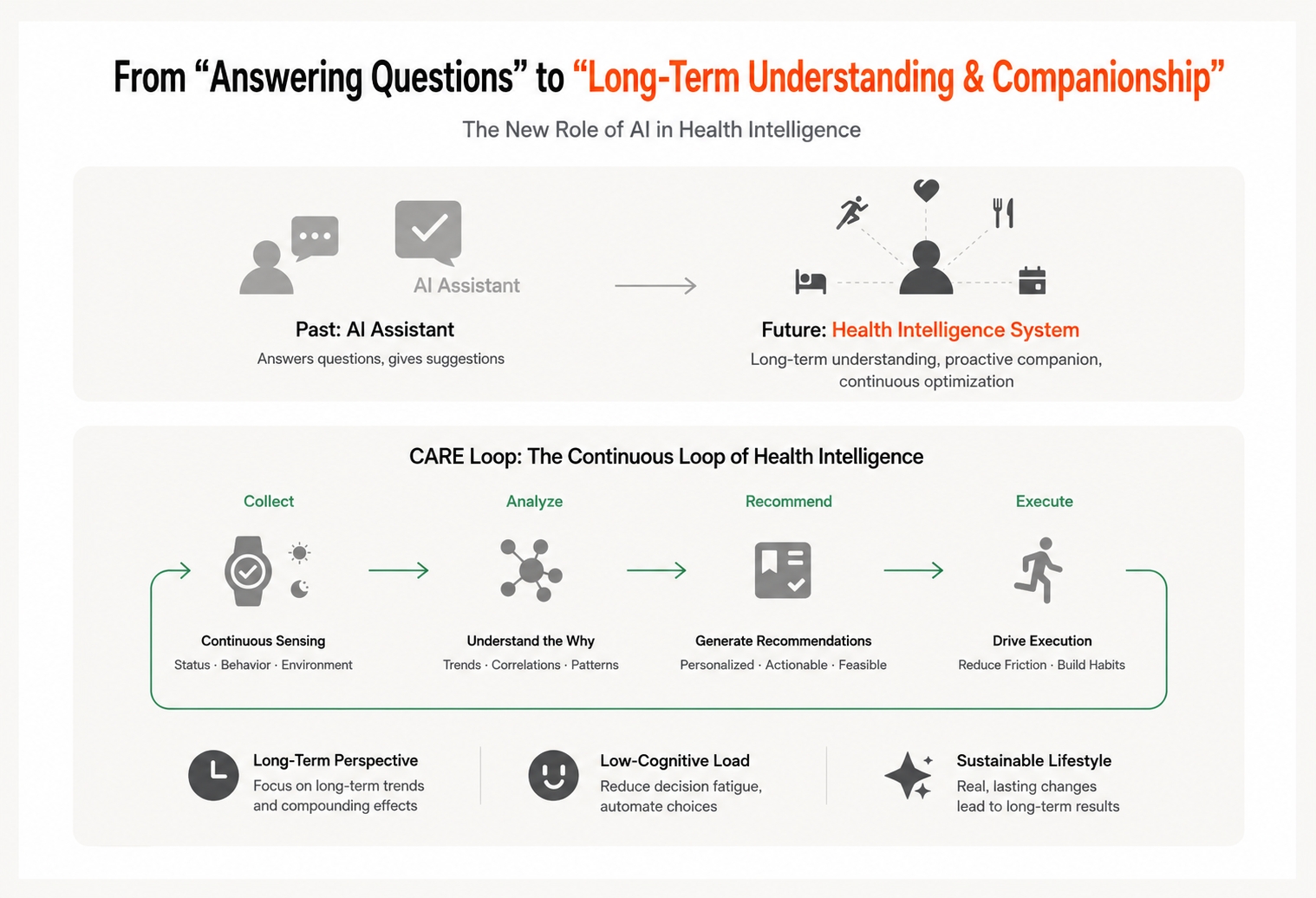
True AI health intelligence should be built on this understanding: health management requires continuously sensing the user's state, understanding the reasons behind state changes, generating action recommendations that fit the current stage, and ultimately helping the user turn those recommendations into real behavior. This is the starting point of the CARE Loop.
CARE stands for Collect, Analyze, Recommend, and Execute. On the surface, it is only four simple steps. But we do not treat it as a product feature list. We treat it as the basic operating structure of a health intelligence system. It describes how AI continuously participates in a person's health process, rather than merely providing answers when the user asks a question.
Many AI products can already complete Recommend, meaning they can generate suggestions. A user describes their goals and situation, and the system provides a training plan, nutrition plan, or recovery recommendation. From the perspective of model capability, this is no longer difficult.
However, recommendation generation alone does not constitute health intelligence. The reason is simple: whether a recommendation is correct does not depend on whether it follows a general rule. It depends on whether it applies to this person at this moment.
To do that, the system must first Collect.
For health intelligence, Collect does not mean simply recording more data. It means continuously understanding a person's complete state. Training, sleep, recovery, work pressure, life rhythm, long-term goals, and behavior habits together form the context required for health decisions. Detached from this context, a single metric often has little meaning.
But data is not the answer. The human body is a highly complex system, and the same metric change may come from entirely different causes. Therefore, after Collect, the system must move into Analyze.
The truly important capability of health intelligence is not detecting data changes. It is understanding why those changes happened, and what they mean for the future. Data begins to create value only when it is transformed into an understanding of the user's state.
On this basis, Recommend becomes meaningful. Recommendation is not only about generating a plan. It is about helping the user make a decision. The system needs to consider goals, state, risk, and real-life constraints at the same time, and find a balance between theoretical optimality and long-term executability.
However, the most easily overlooked and most critical part of the CARE Loop is Execute.
For a long time, the health industry has assumed that if recommendations are accurate enough, users will naturally take action. Reality shows the opposite.
For example, if the system finds that the user has slept poorly for three consecutive days and work pressure is rising, the truly effective approach is not simply to suggest "rest today." It is to proactively lower training intensity, shorten training duration, and give positive feedback after the user completes the session, so the user does not need to make a decision and the behavior can happen naturally.
Truly effective health intelligence does more than provide recommendations. It needs to help users lower the threshold for action, push behavior to happen, and continuously adjust strategy during execution.
When action produces results, new feedback enters the system again, forming the next round of sensing, understanding, and decision-making. This is why CARE is called a Loop, not a Framework.
Health is not a task with an endpoint. It is a continuously running process. Every workout, every night of sleep, and every dietary choice changes the system's understanding of the user, and further influences future decisions.
Over time, what the system accumulates is not only data, but long-term cognition about a person. It starts to understand the user's preferences, habits, risks, sources of motivation, and behavior patterns, and gradually forms a more personalized health management capability.
We are building a health operating system that keeps running
In this sense, we think the future of AI health intelligence is not an assistant that is better at answering questions, nor a more powerful health search engine. It is closer to a health operating system that keeps running.
It can sense your state over the long term, understand your changes, help you make decisions, and push those decisions to actually happen. It does not only know what is good for you. It can help you keep doing the things you already know are good but find difficult to sustain.
This is what we mean by AI health intelligence. A truly valuable health AI is a closed-loop system in which sensing, judgment, execution, and feedback keep cycling.
We believe that the biggest change in the health industry over the next five years will not come from larger parameter counts, nor from more natural conversational experiences. The real change will come from systems that can understand users over the long term, proactively manage complexity, and continuously drive behavior change.
We are building such a system.
Only when AI becomes a long-term partner that truly participates in the health process will we enter the era of health intelligence.